



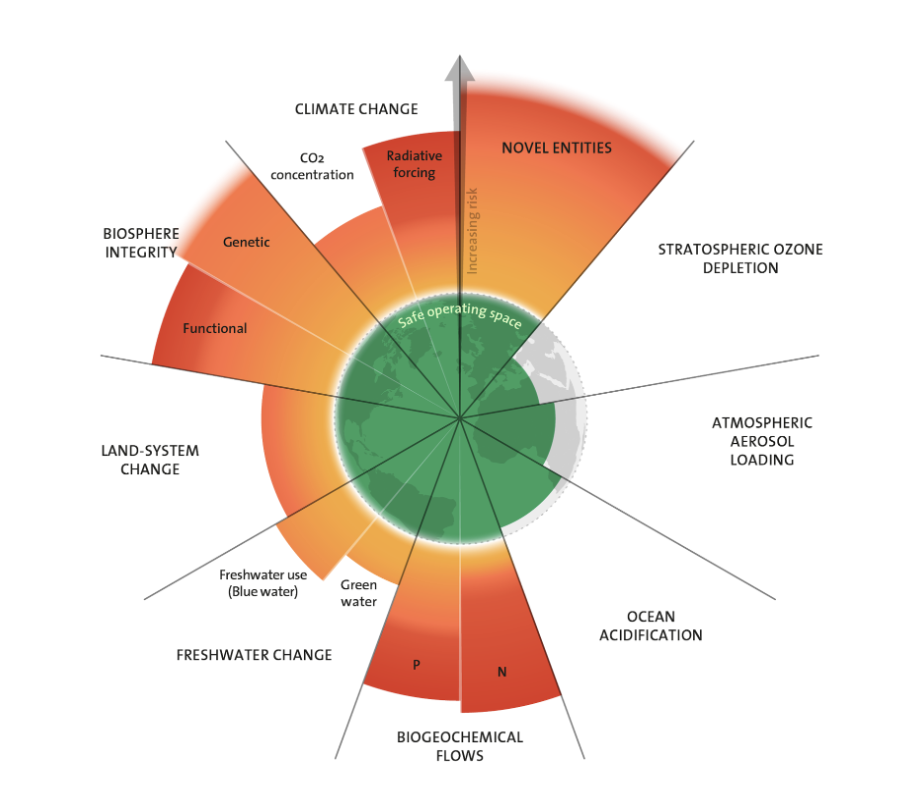
Planetary boundaries are a set of scientifically defined environmental limits within which humanity can sustainably survive. These thresholds establish a “safe operating space” for human development, ensuring that the earth’s systems remain stable and resilient. Crossing these boundaries increases the risk of triggering large-scale, potentially irreversible environmental changes.
The global food system, particularly industrial livestock production, is a dominant force behind the transgression of multiple planetary boundaries. Below is a breakdown of how food and livestock impact each of the seven breached boundaries.
1. Land-System Change
Humanity has significantly altered over 75 percent of earth’s land surface, and land-use change is now four times greater than previously estimated. Agriculture dominates this transformation.
- Livestock is responsible for 65 percent of land-use change since 1960.
- Agriculture occupies about half of all habitable land, and livestock uses around 80 percent of this agricultural land while providing only 17 percent of global calories.
- Cattle ranching causes 80 percent of Amazon deforestation and agriculture drives nearly 90 percent of global deforestation.
- The land footprint required to produce just 1 kilogram (kg) of beef could instead produce 86 kg of bread, 94 kg of tofu, or 45 kg of split peas.
The planetary boundary for land-system change has long been breached, with catastrophic consequences for biodiversity, climate regulation, and Indigenous land rights.
2. Biosphere Integrity
This boundary is considered one of the two “core” planetary boundaries (along with climate change) whose breach could lead to irreversible earth system shifts. Biosphere integrity has been deeply undermined by the expansion of animal agriculture.
- Wildlife populations have declined by 73 percent since 1970, and over one million species are at risk of extinction.
- Threats include habitat destruction, pollution, and climate change, but agriculture is the top driver. Agriculture is the primary threat to 86 percent of species at risk of extinction, and livestock alone has caused 60 percent of biodiversity loss due to land conversion.
- Wild mammals make up only 4 percent of global mammal biomass today. In contrast, livestock makes up 62 percent and humans 34 percent. For birds, poultry represents 71 percent of avian biomass, while wild birds account for just 29 percent.
3. Freshwater Change
The freshwater boundary has recently been added to the breached list, recognizing that both blue water (surface and groundwater) and green water (soil moisture) systems are under extreme stress.
- Agriculture accounts for 92 percent of the global freshwater footprint, and one-third relates to animal products.
- 70 percent of all freshwater withdrawals come from agriculture.
- Livestock production is especially water intensive. One pound of beef requires 1,799 gallons of water; one pound of cheese, 382 gallons; and one pound of bread, 240 gallons.
- The water footprint of pork is double that of pulses (e.g., peas, lentils, and beans) and four times that of grains.
With aquifers depleting and rivers drying up, reducing freshwater stress is essential; transitioning to plant-based agriculture could help achieve that.
4. Climate Change
The climate boundary, set at atmospheric carbon dioxide concentrations of 350 parts per million (ppm), was breached decades ago. We are now beyond 420 ppm and locked into a future of warming, extreme weather, and ecosystem upheaval.
- Livestock contributes between 12 and 51 percent of global greenhouse gas emissions. Differences between these estimations come from how methane emissions are calculated, how indirect emissions from land use changes and related deforestation are accounted for, and whether livestock respiration is counted.
- Key contributors include methane from enteric fermentation (a part of the digestive process of livestock), land use change (especially deforestation), manure management, and feed production.
- Livestock’s emissions exceed those of the entire transportation sector, including all cars, planes, trains, and ships combined. Shockingly, it is estimated that livestock alone will use 49 percent of the emissions budget needed to limit global warming to 1.5 degrees Celsius by 2030.
Plant-based diets offer a powerful mitigation tool for reducing methane and deforestation-linked carbon dioxide emissions.
5. Ocean Acidification
About 30 percent of carbon dioxide emissions are absorbed by oceans, where they form carbonic acid and lower the pH of seawater.
- Oceans are now 30 percent more acidic than during preindustrial times.
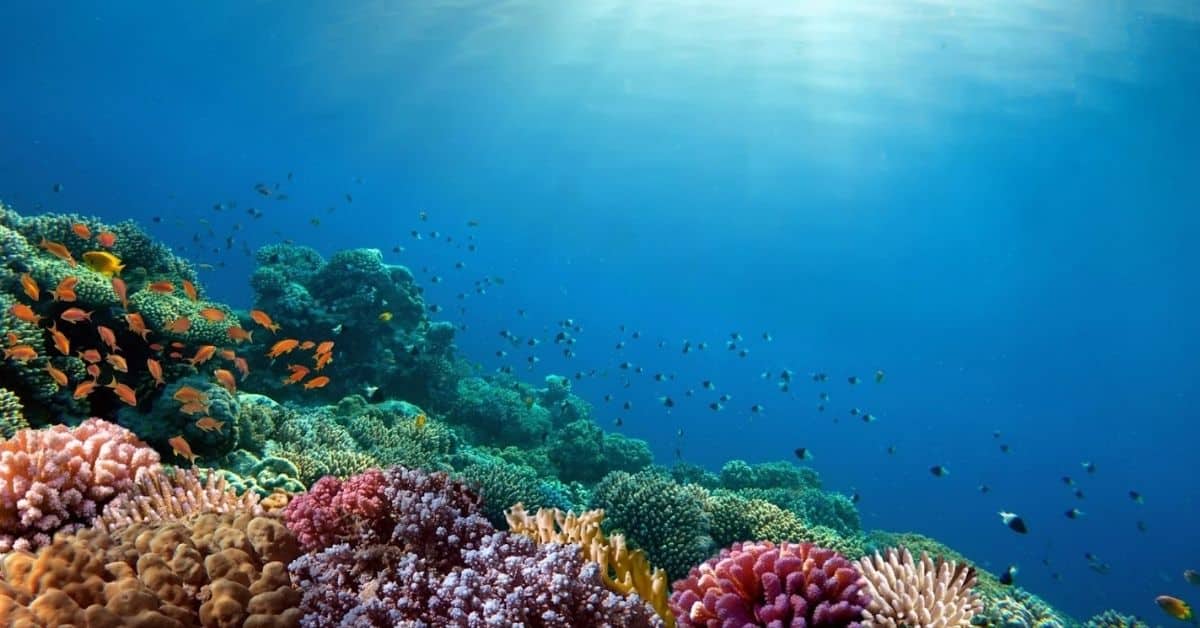
- Acidification threatens key organisms in marine food chains—for example, corals, shellfish, and plankton.
- Emissions from animal agriculture contribute to the overall carbon load.
6. Biogeochemical Flows (Nitrogen and Phosphorus Cycles)
This boundary has been massively exceeded due to industrial fertilizer use and manure overload from concentrated animal feeding operations.
- Two-thirds of applied nitrogen (75/115 million tons) and over half of phosphorus (14/25 million tons) are not used by crops.
- This excess leads to runoff into waterways, causing toxic algal blooms and creating over 415 oceanic dead zones globally, which now extend further into open oceans.
- The largest dead zone worldwide, which is in the Gulf of Mexico, expands seasonally to 22,000 square kilometers.
- Fertilizer-related emissions, particularly nitrous oxide, surpass those of the entire commercial aviation sector.
Reducing livestock feed production would drastically decrease nitrogen and phosphorus use and mitigate these toxic impacts.
7. Novel Entities
This boundary encompasses synthetic chemicals, plastics, pesticides, and genetically modified organisms (GMOs). It was breached in 2022.
- Global production of synthetic chemicals is rising faster than we can assess their safety.
- Over 12 percent of global cropland, and more than half of US cropland, is devoted to GMO cultivation. In the US, GMO usage is ubiquitous: 94 percent of soybeans, 96 percent of cotton, and 92 percent of corn are GMOs.
- 95 percent of livestock consume GMO crops.
- Pesticide use has doubled since 1990, with over 7.8 billion pounds applied in 2021, much of it to glyphosate-resistant GMO crops.
The livestock industry is deeply entwined with chemical-intensive monocultures of corn and soy, driving novel entity proliferation.
The planetary boundaries framework makes one thing abundantly clear: we are living far beyond the safe operating limits of earth’s life-support systems. And at the heart of this transgression is the global food system, particularly industrial livestock production.
From land and freshwater degradation to climate destabilization, biodiversity loss, and chemical pollution, the food we eat is shaping the future of life on earth. Transitioning to plant-based diets is not just a personal health choice—it is an urgent planetary necessity.
You Might Also Like






Copyright 2026 Center for Nutrition Studies. All rights reserved.

Deepen Your Knowledge With Our
Plant-Based Nutrition
Certificate
Plant-Based Nutrition Certificate
- 23,000+ students
- 100% online, learn at your own pace
- No prerequisites
- Continuing education credits